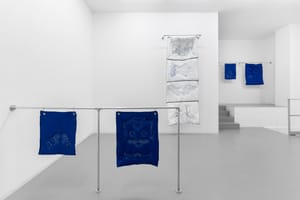
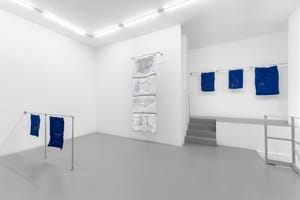
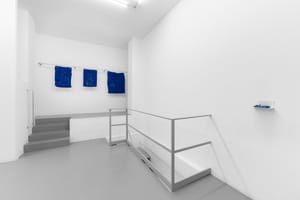
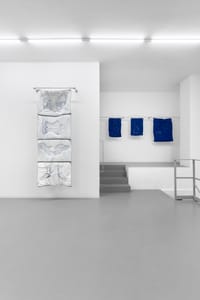
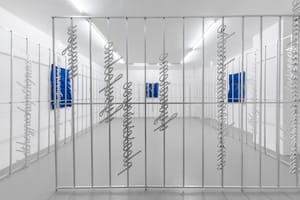
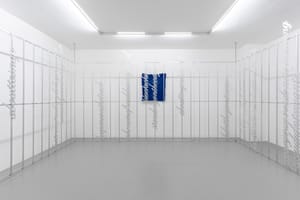
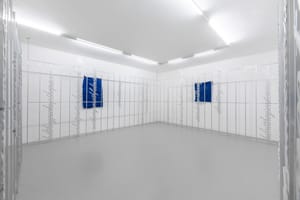
If you feel me, I am you is less a title than a statement. It is an invitation to empathy that directly addresses the viewer, suggesting that recognition is born from shared experience: “If you understand what I am talking about, it is because it has happened to you as well.”
In her first solo exhibition at RIBOT gallery, Simona Andrioletti presents a new body of work that continues her investigation into socio-political activism, systemic violence, and the psychological architectures we construct to survive. Gender-based violence, approached from an intersectional perspective, runs through the exhibition not as a theme, but as a condition that shapes bodies, behaviours, and the spaces we move through.
The exhibition unfolds across two levels. On the ground floor, large quilted works hang from metal structures assembled from construction-site scaffolding tubes. Made from different kind of padded fabrics, suspended by aluminium hooks laser-cut by the artist, these works appear at once soft and guarded. Their padded surfaces in blue and white carry stitched drawings made with a sewing machine, depicting fragments of medieval armour such as helmets and gloves. They read almost like instructions for dressing, for preparing the body for battle. Each quilt becomes an armour, or part of one, holding within it the unresolved tension between care and defence, vulnerability and aggression.
Quilting, a raised stitching technique that originated in the Mediterranean between the 13th and 14th centuries, is historically tied to protection. Andrioletti connects this lineage to medieval gambesons, padded garments worn by soldiers who could not afford metal armour. This history reverberates in the present. For gender-related minorities, protection is rarely optional. It is something learned, improvised, carried. This research extends beyond the quilts into a specially designed bomber jacket for the FLINTA community, equipped with non-violent self-defence tools like anti-spiking lids, a balaclava, and a high-decibel whistle. Objects that acknowledge both threat and agency.
Several quilts appear as fragments, joined by zippers. These closures resemble scars as much as seams, marks of rupture and repair. The zipper becomes a quiet but powerful metaphor to create permanence, to imagine connection beyond separation. Dispersed parts may one day be reunited, closed again. In this gesture, Andrioletti proposes a community that exists across distance, sustained by the knowledge of possible reunion.
On the lower level of the gallery, the visitor must enter a cage in order to see the works. Some of its bars are composed of sentences written by the artist – Broken bones shattered souls – phrases that speak of fear, rage, and bodily memory. Here, language becomes structure and words become bars. Inside, alongside a quilt depicting an helmet, a pauldrons, and a cuirass, appears an image of a woman crying, two women holding each other closely, almost on the verge of a kiss. These figures recall Marian iconography from scenes of the Crucifixion as gestures of mourning, care, and collective grief. We sense that within the architecture of defence, vulnerability persists.
The cage functions as a metaphor for the mind after trauma. A structure built to protect, to contain, to remain alert. It is both confinement and survival strategy. To see the works, viewers must approach the bars, lean in, bring their bodies close. Looking becomes a physical act, an exercise in proximity and exposure.
Fabric, for Andrioletti, is also a carrier of memory. Part of a generation of women artists returning to the female lineage, she produced these works in Bergamo, in her grandmother’s house, which was once the site of a sewing workshop. Working side by side, the making of the quilts opened conversations between the two of them about gender-based violence, about motherhood and reproductive choices, sexual identity, and non-conformity. The act of making became a form of listening, of transmission, of shared reflection.
In the exhibition If you feel me, I am you, personal history and collective trauma are stitched together through gestures of protection and care. The exhibition does not offer resolution, but recognition. It insists that solidarity is not abstract or symbolic, but embodied. It is something learned, worn, and shared. It remains today both a necessity and a fragile, urgent possibility.
Luisa Seipp
Simona Andrioletti (Bergamo, 1990) lives and work in Munich. Her solo and group exhibitions have been held at: Mart, Rovereto, 2026; Eigen Art Lab, Berlin, 2026; Spazju Kreattiv, Valletta, 2026; Kunsthalle Mannheim, Mannheim, 2025; Kunstverein e.V, Munich, 2025-2024; /SAC Bucharest, 2025; Bayrischer Hof, Munich, 2025; Galerie im Saalbau, Berlin, 2025; DG Kunstraum, Munich, 2024; RIBOT gallery, Milan, 2024; Villa Stuck, Munich, 2022; Lothringer13 Halle, Munich, 2022; Museo Novecento, Florence, 2020; Federkiel Stiftung, 2019; Nir Altman Galerie, Munich, 2018; MACRO, Rome, 2017. Awards include: USA-Stipendium, the Bayerisches Staatsministerium für Wissenschaft und Kunst, 2026; Atelierpreis award, the Bayerisches Staatsministerium für Wissenschaft und Kunst, Munich, 2026; Förderung der Chancengleichheit für Frauen in Forschung und Lehre, Bavarian Ministry of Science and Art, 2025; Preis der Akademie aus den Stipendienfonds, Munich, 2022; TalentPrize, 2022.